

Made in Germany · ISO 27001 · GDPR-compliant
LMS for Small and Medium-Sized Businesses
Easily manage professional development digitally—without corporate complexity and with room to grow.
Whether it’s mandatory training, onboarding, certifications, or product training: It’s not the number of employees that determines when an LMS makes sense, but rather the complexity of your training processes. SoftDeCC LMS brings structure to training, qualifications, and certification—without unnecessary implementation effort.
Start with the features your business needs today, and flexibly expand your learning platform as your needs and organization grow.
Less Excel and back-and-forth email, more transparency, automation, and security. Find out how SoftDeCC LMS can benefit your small-to-medium-sized business.
Audit-Compliant Qualification
Hosting in Germany
All Learning Formats

The Wrong Question
At what company size do you need an LMS?
The most common question among small and medium-sized businesses is: "How many employees does a company need to have for an LMS to be worthwhile?" This question is misleading. The number of employees alone says little about whether a company needs a learning management system.
Three other factors are crucial:
1. Training Complexity: How many different training formats, target audiences, and qualification requirements do you need to manage simultaneously—mandatory training, product training, onboarding, and certifications?
2. Structural complexity: How many locations, departments, external target groups (customers, service partners), or languages need to be included?
3. Obligation to Provide Proof: Are you required by regulation to provide proof of training—for example, in accordance with DGUV, GDPR, ISO standards, or industry-specific guidelines?
A company with 200 employees but multiple locations, recurring certification requirements, and external service partners often needs an LMS sooner than a company with 500 employees at a single location without any special compliance requirements. The rule of thumb: As soon as Excel spreadsheets and email reminders can no longer reliably track who was trained and when, it’s time to implement an LMS—regardless of the number of employees.
Intuitive · Automated · Scalable
Why Small and Medium-Sized Businesses Have Different Needs Than Large Companies
Small and medium-sized businesses face a unique conflict of interests: They need the audit trail reliability and process quality of a professional solution, but have neither the budget nor the IT resources for a months-long enterprise implementation project.
!
Quick implementation without a major IT project:
Standard configuration instead of months of customization.
!
Modular Approach:
Start with the core features you need today—and expand only when the need arises.
!
Predictable, manageable costs:
No enterprise pricing model designed for large corporations.
!
A personal point of contact instead of a ticketing system:
This is important for companies that don't have their own large IT department.
!
Grows with you:
When a medium-sized business becomes a corporation, the enterprise features are already available within the same ecosystem—no system change is necessary.
Higher Costs of Failure Than in Large Corporations When a software project fails in a small-to-medium-sized business, the consequences are different than in a large corporation: There are rarely the financial reserves for a second attempt, and rarely the staffing resources to simply rescue a stalled project by bringing in more consultants. Decision-makers at SMEs simply cannot afford to make the wrong choices when selecting software as often—which increases the pressure on every single decision, not just on the overall strategy of a large corporation with the necessary financial buffer.
Organically Developed Structures Rather Than Corporate Standardization Unlike many large corporations, whose processes are often standardized across the entire group, medium-sized companies frequently have company-specific workflows that have evolved over time—precisely because no central IT governance dictates a uniform structure for them. This calls for a system that adapts to existing processes rather than imposing a predetermined structure.
Measurable Results
SoftDeCC LMS by the Numbers
Seminar Administration • Learning Portals • Qualification Management
Features that are particularly relevant for small and medium-sized businesses
Seminar Management & Skill Management in a Single System
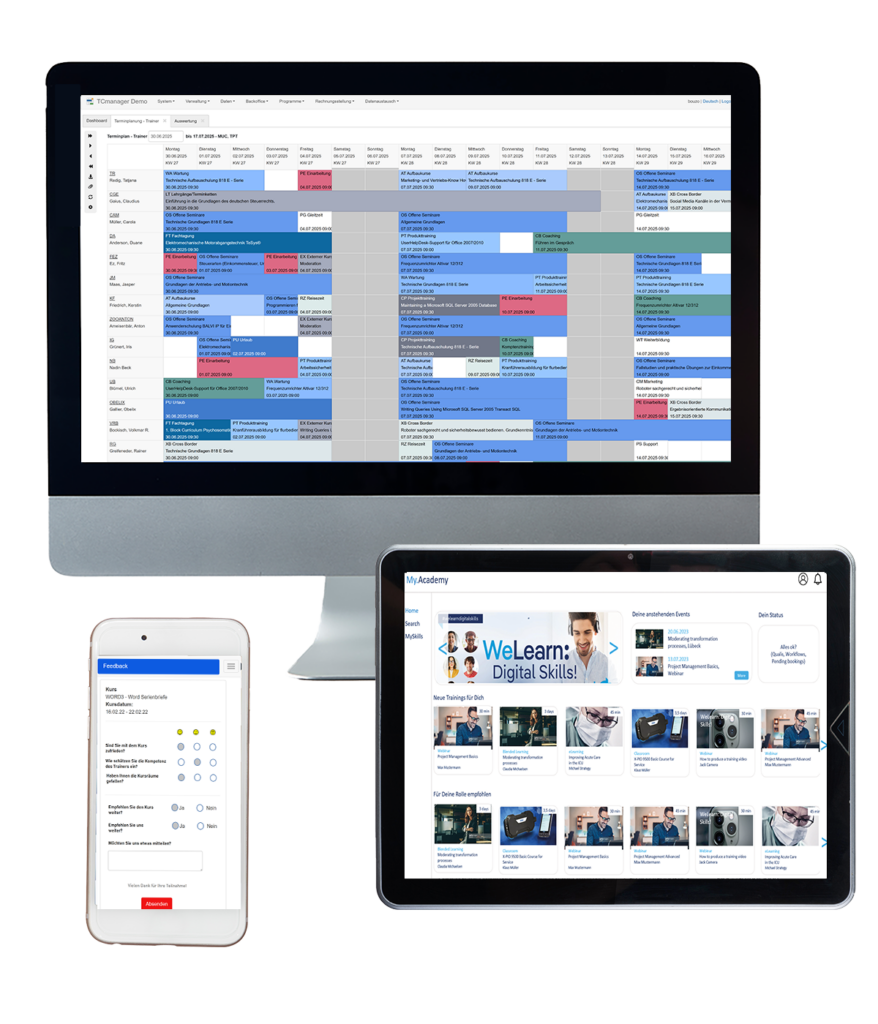
Instead of separate Excel spreadsheets for training planning and certification records: a central platform that combines both—without the configuration effort required for an enterprise-wide solution.
Preconfigured Compliance Templates
Full control over your own infrastructure—ideal for the most stringent compliance and data protection requirements.
Self-Service Instead of Administrative Burden
Employees can view their own certification status; managers receive automatic reminders instead of having to track things manually.
On-premises, cloud, or hybrid—no minimum size required
Unlike many enterprise solutions, the choice of hosting model is not tied to a minimum number of users.
Architecture Designed for Growth
If new locations, languages, or external target audiences are added, modules can be added instead of switching to a different system.
SME LMS vs. Standard
Standard Tools vs. LMS for Small and Medium-Sized Businesses—What's the Difference?
When One Module Is No Longer Enough
Composable Learning Ecosystem
Mid-sized companies often start with a single module—usually the LMS—and realize over time that they need to add additional components such as skills management, training administration, or a learning experience platform. Instead of implementing each module as an isolated, standalone solution, SoftDeCC modules can be interconnected via a shared database.
Checklist
Does Your Company Need an LMS Right Now?
☐
They can no longer reliably verify who completed which mandatory training and when
☐
More than one person handles training administration on the side, even though it isn't anyone's primary responsibility
☐
You have more than one location or are planning to open additional ones
☐
External target groups (customers, service partners, dealers) must also be trained and certified
☐
An ISO certification, a customer audit, or a regulatory inspection recently revealed gaps in the training documentation
☐
New employees are not trained systematically, but rather as capacity allows
Two or more check marks? Then it's worth having a conversation—regardless of how many employees you have
Learn more now
Live Demo & Expert Discussion
Are you unsure whether your company is “big enough” for an LMS? This is exactly the question most of our small and medium-sized business customers ask themselves at the outset.
The answer rarely depends on the number of employees—it usually depends on whether you can prove today who was trained and when.
✓
Over 25 Years of Expertise
✓
Made in Germany
References
What Our Customers Say
Quality & Reliability
YASKAWA has been a customer and user ofTCmanager® since 2015. After an extensive search for a management tool for our training and continuing education division, we are now, following its implementation, glad that we chose SoftDeCC. It quickly becomes clear that this software was specifically designed for training and qualification management. We’re discovering far more capabilities than we initially required or expected. We’re confident thatTCmanager® will help us position our training programs well for the future and improve our efficiency and quality.
Torben Schäfer
Manager, YASKAWA ACADEMY
, YASKAWA Europe GmbH
A Reliable Partnership
TCmanager LMS offers everything you would expect from a software tool for training centers. Today, our extensive training offerings for our service and sales partners and customers are optimally supported worldwide by training portals tailored to specific target groups and countries. The management of schedules, bookings, and resources is logically structured and intuitive to use. Reports can be generated quickly and clearly at any time. SoftDeCC is our reliable partner, with whom we will continue to manage our in-person training and e-learning offerings in the future.
Julia Tillmann
Head of the Training Center at
Maschinenfabrik Bernard Krone GmbH & Co. KG

Support, Customizations, New Features
Hella Academy provides technical training to repair shops and retail partners on our products, as well as on specialized topics such as “Hybrid & High-Voltage” and driver assistance systems. Since 2015, we have been a satisfied customer and user of the TCmanager<sup>®</sup> LMS. We are particularly impressed by the support time and again. Any customizations or new features we request for the application’s functionality are implemented smoothly and help us in serving our customers.
Mark Schulte
Head of Training,
Hella Gutmann Solutions GmbH
Frequently Asked Questions